
High-intensity focused ultrasound has become a prominent technology in clinics and beauty salons offering non-surgical facial treatments. HIFU systems deliver focused ultrasound energy below the skin’s surface, where controlled heating can affect selected tissue layers without making surgical incisions. The treatment is commonly marketed for facial firming, jawline contouring, neck treatments, and the visible signs of skin ageing.
Choosing a professional machine involves more than selecting the newest-looking model or the device with the highest number in its name. Practitioners must consider treatment depths, cartridge options, energy controls, machine reliability, operator training, regulatory markings, and technical support.
A high-quality system should allow the trained operator to work accurately across different facial areas while maintaining appropriate contact with the client’s skin. It should also provide clear instructions, predictable controls, and suitable treatment cartridges for the intended services.
How HIFU Facial Technology Works
HIFU uses concentrated ultrasound energy to create controlled thermal effects at specific depths beneath the skin. The American Institute of Ultrasound in Medicine explains that micro-focused ultrasound targets dermal and subdermal tissue. Controlled heating of selected connective tissue may encourage collagen remodelling and a more organised supporting structure.
The treatment differs from surface skincare because the focused energy is directed below the outer layer. Treatment depth depends on the cartridge being used, the area being treated, and the machine’s approved operating protocol.
Facial HIFU systems often include cartridges designed for several depths. Shallower cartridges may be selected for more superficial facial areas, while deeper cartridges are commonly associated with lower-face and structural treatment protocols. Operators must understand facial anatomy before selecting a cartridge or energy setting.
Research does not support describing HIFU as a replacement for surgery. A systematic review involving 17 studies and 477 participants found moderate short-term improvement in face and neck rejuvenation. The researchers also noted that many studies lacked long-term follow-up and used different outcome measures.
Features to Look for in a Professional HIFU Machine
A professional machine should provide adjustable energy rather than forcing every client to receive the same intensity. Skin condition, treatment area, tissue thickness, client sensitivity, and the selected cartridge may influence the operator’s decisions.
Cartridge selection is equally important. A machine offering several treatment depths gives qualified practitioners more flexibility when designing facial and neck services. The cartridges should be clearly labelled, easy to connect, and supported by detailed operating instructions.
The handpiece should feel balanced during longer appointments. An uncomfortable or excessively heavy handle can make it harder to maintain consistent contact and controlled placement. A responsive touchscreen can also help operators select settings and follow treatment progress without unnecessary delays.
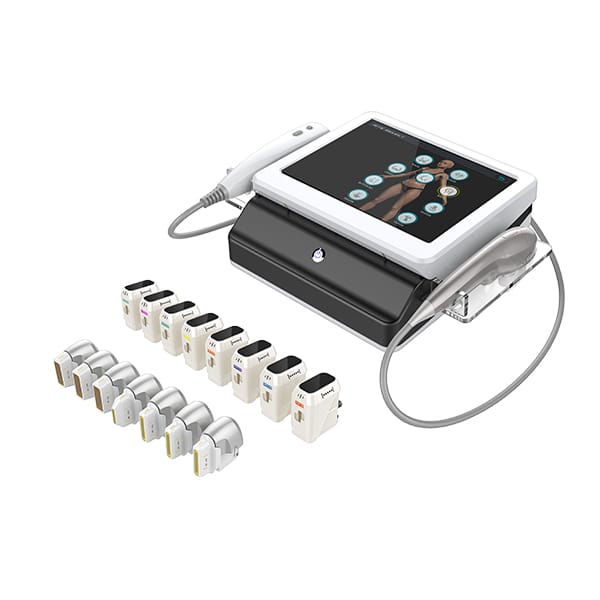
Businesses searching for the best HIFU machine for face treatments can review the 22D MAX system from Glow Beauty Case. It combines a 13D multidimensional facial handle with a separate 18D body-contouring handle, allowing qualified businesses to offer facial and body services from one platform.
Facial Treatment Options with the 22D MAX System
The Glow Beauty Case machine includes three standard cartridges for its facial handle: 1.5 mm, 3.0 mm, and 4.5 mm. These multiple depths are intended to give trained practitioners greater control when planning approved face, neck, and jawline protocols.
The system operates with 2 MHz and 4 MHz HIFU frequency options and provides adjustable intensity from 10% to 90%, according to the supplier’s listed specifications. It also includes a 13.3-inch touchscreen intended to simplify machine setup and treatment control.
A foot pedal is included for hands-free activation, which may help practitioners maintain their hand position while operating the facial treatment handle. The purchase package also includes the main unit, connection cables, a user manual, five standard probes across the facial and body handles, and a 12-month manufacturer warranty for the main unit.
Although the machine includes advanced controls, technology does not remove the need for professional judgement. Facial HIFU requires an understanding of treatment depth, facial nerves, bone position, tissue thickness, and areas that must be avoided.
Why Multiple Treatment Depths Matter
Different facial areas do not have identical tissue structures. The forehead, cheeks, jawline, and neck vary in thickness and proximity to bone, nerves, glands, and other anatomical structures. Using one cartridge across every area without a suitable plan would not provide the level of control expected from a professional service.
A 1.5 mm cartridge is generally associated with comparatively shallow treatment delivery, while 3.0 mm and 4.5 mm cartridges reach progressively deeper target levels. These measurements should not be treated as universal instructions. The exact cartridge, intensity, line spacing, and placement must follow the machine’s training materials and the practitioner’s professional protocol.
The FDA identifies thermal injury, mechanical injury, ocular injury, electrical shock, inflammation, and operator error among the risks that manufacturers must address for focused-ultrasound aesthetic systems. Its guidance also stresses the importance of predictable energy delivery, accurate targeting, suitable labelling, and protection of surrounding structures.
This is why having more cartridges is useful only when the operator understands how to select them. A sophisticated machine in untrained hands can create greater risk rather than better treatment results.
Professional Training and Client Consultation
A detailed consultation should take place before every facial HIFU treatment. The practitioner should review the client’s medical history, previous procedures, current skin condition, treatment expectations, and any possible contraindications.
HIFU may cause temporary discomfort, tingling, redness, or swelling. Excessive exposure or incorrect targeting can damage unintended tissue, which is why the American Institute of Ultrasound in Medicine recommends that only appropriately licensed and trained practitioners perform HIFU and micro-focused ultrasound procedures.
The treatment should not be performed solely because a client requests it. Active skin problems, wounds, unsuitable implants, recent procedures, certain medical conditions, or unrealistic expectations may require postponement, medical clearance, or an alternative service.
Practitioners must also explain that results differ. Glow Beauty Case states on its product page that outcomes depend on physiological characteristics, lifestyle, and the number and frequency of treatments. The supplier does not guarantee identical results for every client.
Selecting Equipment for a Salon or Clinic
Before investing, a business should evaluate its existing client demand. A premium HIFU machine may create new treatment opportunities, but the purchase should be supported by a realistic service menu, pricing plan, consultation system, marketing strategy, and staff training budget.
Businesses should confirm what is included in the price and whether replacement cartridges, training, servicing, and technical assistance are readily available. Downtime caused by unavailable parts can be costly for a clinic that depends on regular bookings.
Regulatory documentation should also be checked carefully. Glow Beauty Case describes the 22D MAX as a CE- and UKCA-marked machine sourced for the UK aesthetics industry. The retailer also lists UK-based customer support and a manufacturer warranty with the package. Buyers should retain their purchase documents, operating manual, training records, and maintenance information.
The ideal HIFU system is not determined by one specification. It should combine suitable cartridges, accurate controls, dependable construction, operator comfort, regulatory documentation, training availability, and responsive after-sales support.
Creating Responsible HIFU Facial Services
A strong treatment service begins with client screening and conservative planning. Practitioners should cleanse and prepare the skin, apply the approved coupling medium, maintain full handpiece contact, and follow the recommended treatment pattern.
The eye area and unintended anatomical structures must be protected. The FDA specifically recommends warnings that stress complete handpiece contact and avoiding ultrasound exposure to the eyes.
Marketing should remain realistic. Terms such as firmer-looking skin, improved facial definition, or non-surgical facial rejuvenation are more responsible than promising permanent lifting or surgical-level transformation.
The best professional machine is ultimately the one a qualified practitioner can operate safely, consistently, and confidently. The 22D MAX offers multiple facial depths, adjustable output, a large touchscreen, separate face and body handles, and UK-focused support. When combined with proper training, careful consultation, responsible settings, and honest client communication, it can form the foundation of a valuable professional HIFU service.